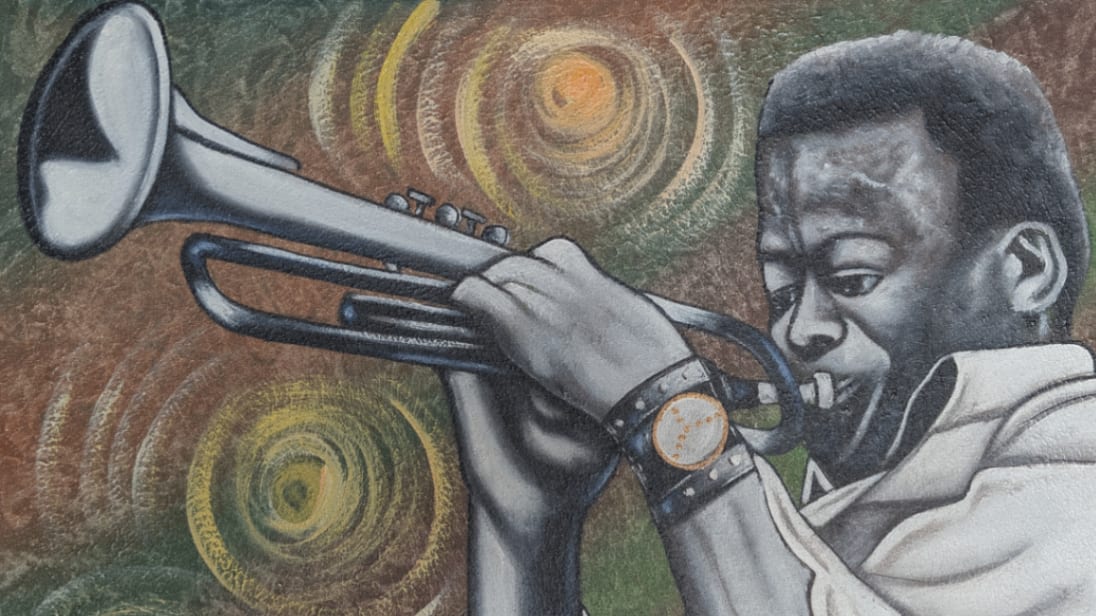
Only Human After All…

Untitled, by Jean Claude Martin
Originally published: July 2, 2026
AI and Music
It clicked this morning.
My wife and I sometimes have a “hangout morning” – we make our coffee, put on music, and just relax with our distraction of choice. This morning, she bounced between YouTube channels, each one clearly being AI-generated.
As a musician myself, I’ve been keeping a watchful eye (ear?) on AI-generated music. I remember the first AI-composed music I generated: Some sort of reggae, island beat. It was actually pretty decent. And AI has improved rapidly since. On this particular morning, though, I noticed that the music, while good, lacked something. At first, I chalked it up to immaturity, in that it had a nice beat and the words sounded right, but the rhythm in the melody felt a little amateurish.
After several of those, we put it on a human-produced song, one composed, arranged, and performed by Cody Fry (Photograph, the symphonic version). It was a stark difference.
Taken aback by this sudden shift, I started listening closely. I had noticed that AI often put passionate-sounding vocals on lyrics that didn't necessarily align with that "emotion". Yet Cody Fry arranged the music so that the lyrical melody AND the accompaniment swelled and subsided at EXACTLY the right time. Why did he get it right while AI didn't? Yes, he's an amazing artist, but I could name hundreds or thousands of other artists who can do the same.
That's when it dawned on me.
Emotions.
The emotions evoked in lyric and accompaniment – the same thing can happen in instrumental music – they're something AI probably will never have.
AI, as far as we’re aware currently, can and will never experience emotions. It will never know the sting of heartbreak, the joy experienced when witnessing a spectacular sunrise, or even the awe felt when examining intricate vein patterns on a leaf.
It will never know how an experience, which became the heart of a song, felt in the moment.
How to translate an experience into quiet, to explosive, to floating, to gravitas.
Humans have been through emotional things. Felt the emotion. And can then communicate it in words and artistry.
Before I knew it, though, my mind made another leap. The music world has known a specific struggle for quite some time: The tension between an artist’s freedom to let creativity flow and the need to achieve commercial success. The two require vastly different things:
Commercial success requires polish, consistency, tried-and-true formulas, efficiency.
Creativity leads to innovation and invention, flaws, variation. And feeling.
Many heated battles have taken place publicly, and even more so privately, over this conflict. Record labels (can we call them that anymore?) tend to win those battles with armies of attorneys and large war chests that artists often don’t have.
AI-generated music is, or is likely to be, perfect for commercial success. Commercial music producers would no longer need to fight it out with artists to get music that suits their commercial needs. AI will get incrementally better at mimicking the emotions present in human-generated music, to the point where most listeners will probably not pay attention to the difference between the two.
But what will we lose in the process?
In 1959, Miles Davis released Kind of Blue. Widely considered the most influential album in jazz history, it would probably never have seen the light of day in a later generation. It’s the pinnacle of creativity, with an interesting twist. Davis effectively gave himself prompts, constraints, limits, and then proceeded to write some of the most innovative music of that time. It’s the opposite of that wild, be-bop, frantic music that some may picture jazz to be.
It was also flawed. Davis, on trumpet, “cracks” while playing; mix levels are often incorrect, to the point where the piano or upright bass is almost inaudible; it’s only five long songs, rather than sticking with record labels’ favorite formula of 10 songs of 3-4 minutes in length. In short, it would be a nightmare for a record label today. The only thing the label would have liked is that the 6 musicians on the album only took 9 hours of recording time over two days, instead of booking a month in an extravagantly expensive studio.
And yet, it has outsold all other jazz albums in history.
Left vs. Right Brain
In the last century, neuroscientists started looking at the difference between how the two hemispheres of our brain work. The theory became that the left brain took care of the analytical side of our thinking, while the right side is where creativity and emotion took place. As I understand it, there’s a lot more nuance to what each region of the brain does. But as an illustration, it does nicely.
Our society has increasingly valued analytical, objective, logical, “left-brain” thinking, relegating the creative, emotional, spiritual “right brain” to frivolous pursuits or the precious few "talented" people.
AI, as it turns out, is neither emotional nor creative. When it is prompted, it generates words, images, sounds (but thankfully not smells, at this point) based on patterns it has been fed. Anything that hints at emotions and creativity results from mimicking humans’ emotional or creative work.
AI is perfect for the business world. Businesses value consistency, accuracy, efficiency, measurability – all left-brained traits. It's been that way for a long time. And business, in general, has had an outsized influence on shaping our society.
On the other hand, the most meaningful parts of our lives are soaked in emotion. Love, which I believe to be the center of life, is inextricably woven with emotions. Creativity requires emotion to really be creative. Relationships are saturated with emotion.
The Reckoning
It’s hard to avoid discussion and controversy over AI.
“It’s brilliant! It created a presentation in five minutes that would have taken me all day! Now, I can live a life of leisure while AI does all the hard things for us!”
“Fear it! It’ll take our jobs and then take over the world while either killing or enslaving us!”
We’re still writing the future, one day after the next. The future reality will doubtlessly land somewhere between utopia and dystopia – if you study history, the wonderful and the challenging tend to balance each other over time. AI’s impact will also be felt differently for different people, depending on circumstances.
But I think Miles Davis, artists of all kinds, spiritual practitioners, craftspeople, caregivers, give us the inspiration for how to move forward in an increasingly AI-influenced world: Double-down on the things that differentiate humans from AI. The Right Brain.
Making things with your own hands or buying them from an artist or craftsperson, appreciate the effort and hardship that went into making them, and seeing flaws in the human craft as features to embrace.
Learning to view the world with awe, to recognize each of us is but one of roughly eight billion people, one of trillions of organisms on this earth, on one of countless planets, in just one of innumerable solar systems, inside an unfathomable number of galaxies.
Focusing on person-to-person relationships and face-to-face interaction, rather than digital substitutes.
Perhaps the greatest benefit of AI will be that it helps make us more human.
(Footnote: This article was 100% human written. The included dashes “–“ were inserted by me, not an AI program.)